


We’ve done this once before, counting out some examples of copaganda in media. Now we’re back, and bringing you five more instances of copaganda in media.
Before we begin, a quick reminder of what copaganda actually is. Copaganda, as I wrote it in the first installment of this series, is “propaganda that normalizes, valorizes, or otherwise paints policing in a positive light. More than that, it paints policing as natural, something so imperative to a functioning society that it becomes almost synonymous with safety, the single thread that keeps society from instantly unraveling.”
Where might we find copaganda in our everyday lives and media, you ask? Allow me to show you.
Let’s begin.
1. To Catch a Predator


Description: A reality TV show in which NBC Dateline reporter Chris Hansen confronts online predators who show up to the sting house.
Where’s the Copaganda? Everybody hates child predators. So everybody loves watching a child predator have the worst day of their life.
Watching this grown man walk into a house where they thought they’d be meeting a child to [redacted], only to come face-to-face with Chris fucking Hansen? The look on their face when they see him, and when they hear the dreaded, “Why don’t you take a seat right over there?”
Getting humiliated on live television, exposed to the world as the lowest of the low, the worst of humanity, and then getting arrested to top it all off?
Delicious.
A show like this is the ultimate schadenfreude, justice delivered on a silver platter. Who wouldn’t love that? Who doesn’t love seeing a child predator get tackled to the ground while he shouts, “Oh, Lord!” into the grass like a goober? Or Hansen’s little one-liners when he comes out to greet a creeper like it’s just another Tuesday (“No hug for me?” “Hey, boo.” “Hey, Tex, how ya doing?”)?
I love TCAP. I like a lot of the media on this list. But I think it’s important to really analyze copaganda in media and how effective it can really be. The sense of justice we feel at watching these predators get humiliated on TV and then arrested glosses over the reality of policing and the fact that most sexual violence crimes don’t get reported, and if they do, as few as three out of every one hundred rapists will ever actually face even a single day in prison.
Is it super satisfying to watch predators face justice? Of course. But don’t let it fool you into thinking that that’s the norm by any means. As discussed in the first post, it’s not uncommon for police departments to work with the media if that media makes them look good. And their appearance on TCAP definitely makes them look good.
2. Men in Black (all of them)


Description: A human-policing cop becomes an alien-policing and immigration cop when he joins the secret organization, the Men in Black.
Where’s the Copaganda? gestures everywhere
Again, I like this series. It’s a fun watch. But this is policing amped up to another level through an undercover organization that polices and manages the comings and goings of alien lifeforms.
“You’re overthinking it, Noodles. It’s just fun media for you to enjoy.”
So is everything else on this list. And the portrayal of immigrants as literal alien lifeforms potentially dangerous to all of humanity is a little too on the nose to just ignore. The first movie shows an alien crashing into a farmer’s truck, destroying it, then promptly sucking all the meat and bones out of him and claiming his skin as its own. Sure, the farmer was a massive douche, but the implications are the same: aliens are taking over. They’re coming to take errr jerrrbs, our livelihoods! We need a heroic organization to keep tabs on them and keep the bad ones out!
Enjoyable as the series may be, the fact that it’s copaganda remains: the MIB is a policing organization that defends our homes from alien lifeforms seeking asylum, many of whom often look to cause problems or even endanger all of humanity.
It might be more of a reference to border patrol than beat cops, but both count as copaganda as far as I’m concerned.
3. The House of the Dead
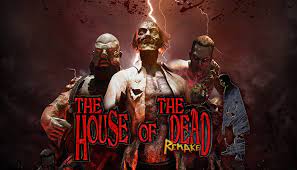

Description: The fictional law enforcement organization, the AMS, is sent to stop the mad scientist Dr. Curien from unleashing his hordes of undead on the human populace.
Where’s the Copaganda? Humanity is on the verge of a zombie apocalypse, and it’s up to two totally-not-cops to stop the evil scientist from seeing his plans to fruition.
Lots of copaganda involves cops saving the day, if not the entire world. The House of the Dead is no exception, featuring a cop player-character in Thomas Rogan, who works for the AMS and is tasked with investigating the activities of Dr. Curien and his hostile, zombie-like entities.
I’m gonna be real with you: if cops can’t even enter the same room as an active gunman who is in the middle of murdering 19 children and 2 teachers, I don’t know how realistic it is for a single cop to brave a mad scientist’s mansion to stop his army of grotesque abominations, all on (presumably) a cop’s salary. But copaganda tends to portray the police as endlessly brave and noble, diving into danger without sparing a single thought to their own safety and well-being. While I’m not saying that there’s no such thing as a cop who fits this description, I am saying that they’re few and far between.
4. Across the Spiderverse

MASSIVE SPOILER ALERT
Description: Spiderman Miles Morales travels across the multiverse, where he encounters various Spider-People from other dimensions.
Where’s the Copaganda? Shut up, do not start with me.
I love, love the Spiderverse. As an Afro-Boricua woman with a Puerto Rican mom and a Black dad, both from New York City, this is a piece of media that’s really near and dear to my heart. I have never related more to a character than I do with Miles Morales and his family, and that’s simply a fact.
However, copaganda is still copaganda, man. And the fact is, police are a huge part of the whole Spiderverse apparatus, with important people in the various Spidermens’ lives often being members of law enforcement. In fact, these members of law enforcement are literally part of the canon, with their demise being another part of the canon that Miles rebels against the entire Spider-Society to prevent from happening in his own universe—to save his police officer father after he’s promoted to captain.
I’m holding out hope that there will be some kind of commentary on policing in Beyond the Spiderverse, but as it stands right now, this wonderful piece of media unfortunately needs to end up on this list…because it is copaganda.
5. Explore With Us/JCS Inspired/A&E/Law & Crime Network (and other true crime documentary YouTube channels)


Description: YouTube channels that cover murder investigations by analyzing police interrogations.
Where’s the Copaganda? You might be thinking, “Noodles, analyzing a police interrogation video is hardly copaganda. It can be completely neutral in its handling of the case.”
Sometimes this can be somewhat true, particularly when these channels remain objective enough in their analysis to acknowledge what’s done right, while also being willing to criticize what’s done wrong in each case. I’ve seen EWU do this with a case where the interrogator failed to build “rapport” with the suspect, which is a common technique of interrogators to build a bit of trust with the person they’re interrogating to more effectively coax information out of them.
However, in many cases, that’s…still kind of the problem. Most of these channels analyze what is known as the Reid technique, an interrogation tactic popularized by John E. Reid in 1955. The technique has three stages, each one intended to get the suspect to let their guard down and slowly crumble under pressure: factual analysis, behavior analysis, and interrogation.
According to psychologist Saul Kassin in his book on false confessions, Duped, one of the problems with the Reid technique is that it assumes guilt and is “preceded by a ‘neutral’ interview, wherein police determine on a hunch masked as science whether a suspect is lying or telling the truth.” The entire technique is grounded in what is essentially pseudoscience: reading body language and assuming guilt based on how uncomfortable or shifty the subject appears. It does not account for every individual being different, and people reacting to stressful situations in different ways.
The reason I mark YouTube channels such as Explore With Us as copaganda despite enjoying them myself, is that they tend to analyze the result of interrogations using the Reid technique exactly the same way police do. Although the Reid technique has resulted in numerous false confessions, these YouTube channels analyze things like body language and tone, and tend to come to the same conclusion as the police…guilty.
–
If you liked this post, check out the first one!