
 By Alex Roma
When you think of high fantasy, what comes to mind first? For many readers and writers, it’s JRR Tolkien’s Middle Earth — and there’s a reason for that. Even with The Hobbit published almost 90 years ago, Tolkien’s world and stories still inspire much of the genre today. From video games to books to movies, the worlds are still being built on that blueprint: low technology, full of kingdoms and swordfights along with the dragons and wizards. “Medieval fantasy,” it’s often called — and usually Eurocentric medieval fantasy.
And look, I like a good medieval high fantasy. I play Dungeons & Dragons voraciously. I’ve even written a medieval high fantasy (more on that later). But I do think that we’ve done ourselves a disservice in letting one type of setting become the default for the entire subgenre. Particularly when it comes to the idea of “historical accuracy” within fantasy stories.
It seems like a bit of an oxymoron on the face of it, right? Historical accuracy of a world that doesn’t exist and never did. But I’ve seen readers complain that they were put off to a fantasy series because the dialogue included phrases like, “yeah” or “come on.” I’ve seen writing guides telling fantasy authors that it’s inaccurate to have their characters eat certain foods, because those foods were not widely available in “medieval times.” And it’s been used to justify holding on to poor treatment of marginalized characters in high fantasy because, “That’s what it was like back then.”
I think this can limit our imaginations, in a genre that many of us were drawn to because of the wonder and wild imaginings that come with it. Of course fantasy writers have to make their worlds familiar or relatable in some way in order for them to make sense to the reader. But does it always have to be the same medieval pastiche scene? And does that scene have to be “historically accurate”? Here’s why I think it might be time to let that go.
The Myth of “Historical Accuracy” in High Fantasy
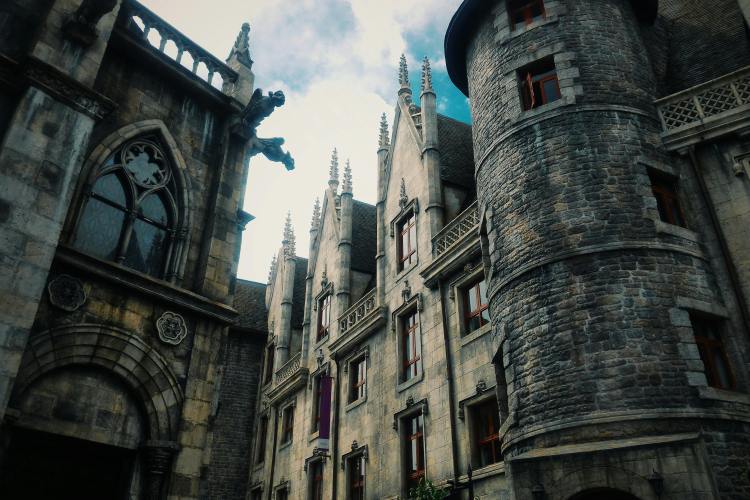
Let’s go back to Tolkien, just for a second. The truth is that while Lord of the Rings may be held up as the holy Scriptures of this kind of “medieval” high fantasy, it’s not actually very historically accurate to medieval England — or medieval anywhere for that matter. Tolkien was a philologist, and he certainly brought that understanding of historical development into his writing, but he wasn’t beholden to our history.
In Middle Earth, there are wide stretches of open, untamed fields with nary a house or tavern in sight. But medieval England was crowded, with busy cities, narrow streets, and millions of people (including, it has to be said, more than two women). The two human kingdoms — Gondor and Rohan — resemble that noble, Arthurian sort of ideal of a medieval kingdom, with none of the squalor and mess of reality. Because Tolkien, who started writing about Middle Earth after fighting in World War I, was writing about an ideal. A world where, no matter the hardship or the evils that existed, good would rise up and prevail. A world where people were brave and full of conviction and nature was respected.
George R.R. Martin’s Westeros is a much harsher world, and he speaks often of how he based the world off of the War of the Roses in, again, medieval England. But even with that inspiration, A Song of Ice and Fire is not “historically accurate.” In fact, Martin’s been criticized more than once for the gratuitous sexual violence and limited freedoms of women in his stories, as well as his portrayal of non-Western cultures, because even from a “historical” standpoint, it’s pretty extreme and horrific.
But just like Tolkien, Martin’s Westeros need not be historically accurate. It’s not about history. “Historical accuracy” in a fantasy setting…doesn’t really matter. We’re talking about a world with monsters and magic. We’re talking about a world that was born in the author’s imagination, that has its own history and developed separately from our world because it has resources that we don’t. So what if the main characters eat food that wouldn’t have been available to the common people in the Middle Ages? Maybe in this world, food processing has advanced past that already. The guy next to you in the tavern just called his parents from a rock, so food processing seems like a weird thing to get hung up on.
Also, just as a side note on dialogue that “breaks immersion,” I can almost guarantee that the way characters spoke in The Lord of the Rings is not accurate to the way people spoke in medieval England. The practice of writing dialogue that is accessible to your contemporary readers is a pretty old one.
The Freedom of Fantasy

My favorite thing about fantasy is that I can let my imagination run wild with it. In fantasy, especially high fantasy, you’re creating a world. That world will have rules, and it should make some kind of sense, of course. But you get to decide what those rules are. You’re not accountable to history or realism, just consistency within your worldbuilding. You’re also not accountable to make your fantasy world just like all the other popular fantasy stories you see on the shelves. It doesn’t have to be medieval Europe with dragons.
The medieval world itself was richer and more diverse than just medieval Western Europe. There were different religions, gender norms, fashions, and architecture that are often forgotten about in discussions of “historically accurate” fantasy. But even beyond that, there’s so much more that you could pull on for inspiration than simply the medieval period, of any culture. Nor do you have to pull all your inspiration from the same place.
I like characters in my worlds to have swords because I think swords are fun. I also had an idea the other day for a type of fantasy public transportation while I was riding the light rail home. When I build a culture, I look at the resources they have and the type of landscape they live in and then I look at a bunch of different cultures that have similar landscapes and resources. I also think about how magic and relationships with the other countries and continents would impact them, so that the end result doesn’t look like just one thing. I do the same thing for technological advancements: what’s possible? What makes sense? Maybe they don’t use electricity, but they do have magic, so have they figured out similar solutions? If not, why?
Think about the buildings you see as you walk down a familiar street. Are they all from the same period of time, made in the same style, with the same inspiration? Probably not. On American residential streets particularly, you could find a craftsman next to a Tudor house across the street from a big colonial building. The real world is a hodgepodge of different inspirations, and that’s how I like to think of fantasy worlds. Maybe the way you develop fantasy worlds and stories is different; and that’s okay! The fantasy genre is basically one big sandbox. We don’t all have to make the same kind of castle.
What About Urban Fantasy?

You can probably tell that this is a topic my friends have been subjected to a few times, especially when I say that fantasy doesn’t just have to be medieval. And one of the responses I get is, “So urban fantasy?” And my answer is, “No, not really.”
Urban fantasy has a different expectation and fills a different niche than high fantasy. Urban fantasy is by definition…urban. It’s all about these different fantasy elements crowded together within a city, making for a magical or paranormal powder keg. It’s why you get a lot of urban fantasy detective stories. Frankly, it’s also why you get a lot of the old vampires vs. werewolves vs. witches or fantasy race war tropes.
I love a mystery. I love urban fantasy. But that’s not what I mean when I talk about high fantasy stories that don’t rely on historical accuracy. First of all, urban fantasy is still bound to a set real life time period — our current time period, or sometime in the near future. What draws me to high fantasy is that sense of wonder, the sense of being transported elsewhere and going on a sweeping adventure. The adventure might not be bright and happy. Oftentimes, it’s gruesome and bloody. But it is transportive; it takes me somewhere else for a while. Urban fantasy, on the other hand, takes all of the something elses and brings them to me.
So let’s forget about urban fantasy for the purpose of this discussion. Here, we’re talking about those big, sweeping high fantasy tales. The juicy political intrigue or the thrilling adventures, or both in the same book. What I want is to see those stories in lots of different worlds, with lots of different rules, without being beholden to arbitrary rules that lead to the same kinds of stories.
Why I Wrote a Medieval Fantasy

It might seem a little hypocritical that my first published novel, The Wounds of Wisdom, is a typical medieval European fantasy. In fact, I even did a lot of research on resources that would have been available at certain times in medieval England in order to write the book. There were a couple reasons why I did this.
The first was that it’s slightly Arthurian legend inspired. If you squint. The Wounds of Wisdom combined an idea that I tossed around with my best friend and my desire to write an Arthurian story centering around Guinevere. As most stories do, it turned into its own thing, but some of the original inspiration is still there. I remember, when I read The Once and Future King, being obsessed with the way TH White wrote Arthur, Guinevere, and Lancelot. He wrote a Lancelot that was as deeply in love with Arthur as he was with Guinevere, and an Arthur and Guinevere who maybe didn’t love each other romantically but did very much love each other. That was the sort of dynamic that I wanted for my heroine, my legendary (but reluctant) soon-to-be king, and his prickly but devoted guard.
The second reason for the medieval setting is something I wanted to explore as the trilogy went on, and I’ve been excitedly doing so as I draft book two. I wanted an old-fashioned kingdom to show the consequences of their isolation. Artrus as a kingdom has been closed off from the rest of the world for over 300 years by a magical boundary wall — almost no one gets in or out. There’s no trade (legally, that is) and no interactions from neighboring countries. Their understanding of world history stops 300 years ago. But in the outside world, there are airships and plumbing and whole continents that the people of Artrus don’t even know exists. The world I wrote for the Time’s Sacrifice Trilogy is not a medieval world, but Artrus is a medieval kingdom. Because they’re literally stuck in the past.
All this to say, there’s nothing wrong with writing a fantasy that has a medieval Europe inspired setting. Most of us have read and loved many books like that. But I don’t think that should be the default. High fantasy has the potential for so much more variety, and that variety exists. Part of opening those doors for more is not making assumptions about what might be realistic based on “historical accuracy.” It’s time to let that go.
Recommendations
This blog would not be complete without shouting out some books that do break out of that usual medieval European high fantasy mold, while still being high fantasy. If you’re looking for some examples, or just a really good read to sink your teeth into, consider a few from this incomplete list:
- When the Stars Alight by Camilla Andrew
- The Foundryside Trilogy or The Divine Cities Series by Robert Jackson Bennett
- The Inheritance Trilogy or really anything by NK Jemisin
- The Green Bone Saga by Fonda Lee
- Kingfisher by Patricia McKillip
- Between Earth and Sky series by Rebecca Roanhorse
- The Books of Ambha by Tasha Suri

…